Welcome to eastern Gotland
Here we have gathered some tips for those visiting Gotland for the first time, or for those who are here again and
may want to experience something new.
Eastern Gotland is often described as peaceful and close to nature. Here you will find open landscapes, long sandy beaches, and small, authentic fishing villages. The pace is a bit slower than on the western side, and many of the places still feel untouched. A special bonus is that on eastern Gotland you can experience some of the island’s most beautiful sunrises over the Baltic Sea.
Nature experiences and beaches
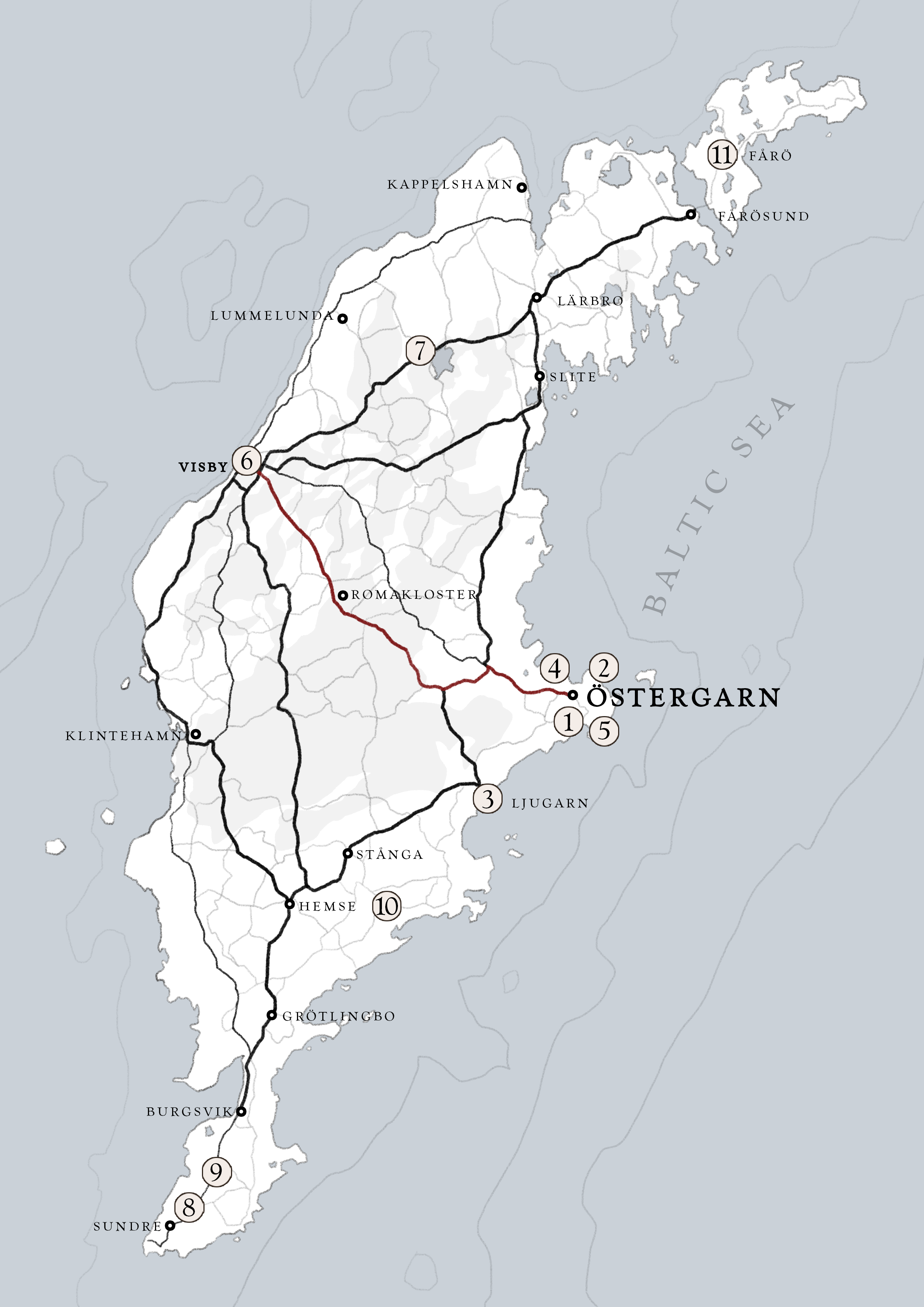
(1)Sandviken, located right next to Falhammars where the wedding reception will take place, is one of the finest beaches on the east coast. It is a long, wide, and shallow sandy beach, perfect for both swimming and relaxation. The beach is over a kilometre long and is surrounded by sand dunes and low vegetation, which creates a sense of space and untouched nature. Sandviken is also a nature reserve, which means the environment is protected and well preserved. There are good opportunities for picnics, walks, and peaceful swimming, and the area is especially appreciated for its clear water and open coastline. Another nature tip is to visit (2) Grogarnsberget in Östergarn. Here you get both a magnificent view of the sea and the opportunity to see traces of an ancient hillfort. Also make sure to visit (2) Kuppen, located east of Herrvik. Here you will find fantastic views of the sea and Östergarnsholm, which lies offshore from Östergarn. A nice stop is (3) Ljugarn, one of Gotland’s oldest seaside resorts dating back to the 19th century. It has a long, child-friendly sandy beach and a lively summer selection of restaurants and cafés. Just north of Ljugarn is (3) Folhammar rauk area, an impressive area with rauks, natural limestone formations shaped by sea and wind over thousands of years. The landscape is dramatic and perfect for photography, especially in the evening light. Another popular feature on Gotland is swimming in old limestone quarries. The clear turquoise water creates an almost exotic feeling and differs from the usual sandy beaches. There are several quarries mainly in the north,
for example at Blå Lagunen and Smöjen.
Please note that there can be dangerous underwater currents in some places, for example at Kuppen in Östergarn and at Heligholmen in Sudret. Follow local information and feel free to ask where it is safe to swim.
Coastal life and fishing villages
Along the east coast of Gotland there are several small fishing villages where you can experience traditional Gotlandic coastal life.
In (4) Katthammarsvik there is a lively harbour setting with restaurants and a smokehouse, perfect for lunch. The smaller villages (2) Herrvik and
(5) Sysne offer an even calmer atmosphere.
Here, the experience is more about tranquillity, sea views, and an authentic setting than activities. In Herrvik there is a restaurant, and in Sysne a smokehouse where you can buy a good fish lunch to enjoy in the harbour.Along the east coast of Gotland there are several small fishing villages where you can experience traditional Gotlandic coastal life.
Allemansrätten, The Right of Public Access
The Swedish allemansrätten, Right of Public Access, is a unique principle that gives everyone the right to move freely in nature, regardless of who owns the land. It means you can walk, swim, cycle, and camp temporarily as long as you show consideration for nature, animals, and landowners. The basic rule is “do not disturb – do not destroy,” which makes it possible to experience Sweden’s landscapes in a free but responsible way. Do not stay too close to residential houses and pay attention to signs, for example regarding fire bans or areas where livestock are grazing.
Hiking
It is easy to hike along the coast, and there are many hiking trails throughout Gotland. One tip is to follow parts of the East Coast Trail (Ostkustleden), a hiking route that runs along the coast and allows you to experience the landscape up close.
Remember to bring a packed lunch!
Museums and cultural experiences
To understand Gotland’s history and culture, it can be valuable to complement nature experiences with a visit to a museum.
Some local museums in Östergarn
In Herrvik there is (2) the Albatross Museum. The museum tells the story of the German minelayer Albatross, which in 1915 was damaged in combat and ran aground at Östergarn. Objects, photographs, and documents connected to the event and its aftermath are displayed, including how the crew was interned on Gotland. This provides a unique perspective on Gotland’s role in international history.
You can also visit the memorial stone (Albatrossstenen) between Herrvik and Sandviken. It stands close to the site where the ship ran aground and commemorates both the naval battle and the sailors who died.
Nearby there is also a small (5) fishing museum in Sysne harbour. These types of local museums show how fishing has shaped life along the east coast and give insight into everyday life in Gotland’s fishing villages.
Other interesting museums One of the most important museums on Gotland is (6) Gotland Museum in Visby (Fornsalen). Here you get a broad introduction to the island’s history – from the Stone Age and Viking Age to the Middle Ages and beyond. The museum is one of Sweden’s most visited county museums and holds large collections of artefacts and picture stones.
You can also visit museums with different focuses, from (7) the military museum in Tingstäde to the art museum (8) Körsbärsgården on Sudret and the museum of the artist (9) Lars Jonsson in Vamlingbo. All are well worth a visit for those interested.
Also well worth a visit is (10) Stavgard Viking Farm in Burs, especially for those interested in Beowulf. The story of Beowulf is one of the world’s most famous heroic sagas. It was written down in Old English over a thousand years ago, but is set in the Nordic region and tells of heroic deeds, kings, and battles with monsters. What makes Gotland particularly interesting is that there are theories linking Beowulf to the island. Some researchers believe that the people called the “Geats” in the poem may have been Gotlanders (Gutar), and that parts of the story may have their origins here. Stavgard is an open-air museum that works to bring Gotland’s early history to life, including connections to Beowulf. Here you can experience reconstructed environments, longhouses, and guided tours that connect myth and reality.
Norrlanda open-air museum shows what rural life looked like in earlier times.
Find more museums, and check opening hours, here: https://www.sv.se/avdelningar/sv-gotland/museiguide
Churches on Gotland
The churches on Gotland are numerous and an important part of the island’s cultural heritage. There are around 100 churches on Gotland, of which approximately 92 are medieval and still in use. The churches were mainly built during the 12th and 13th centuries in limestone and reflect the island’s rich medieval history.
Many are well preserved, and together they make Gotland known as “the island of a hundred churches”.
The churches on Gotland are not only religious buildings, but also some of the best-preserved medieval structures in Sweden, filled with art, frescoes, and history.
Visit Fårö (north of Gotland)
(11) Fårö is an island north of Gotland, known for its rauks, sandy beaches, and rugged landscapes. The island is reached by a free ferry from Fårösund and immediately feels different from the rest of Gotland.
What you can see when visiting Fårö:
Langhammars rauk area – an iconic landscape with sea-adjacent rauks
Digerhuvud – one of the largest rauk fields in Europe Norsta Auren – one of Gotland’s most secluded and untouched beaches, where soft sand, open sea, and silence create an almost deserted feeling of nature.
Fårö Lighthouse – a viewpoint with panoramic sea views
Bergman Center – Fårö is also known as the place where film director Ingmar Bergman lived and worked. The Bergman Center is a cultural centre and museum entirely dedicated to the film director Ingmar Bergman and his time on Fårö.
Sylvis döttrar – a well-known summer café appreciated for its homemade fika. Here you can order the classic “seven kinds of cookies”.
Kutens Bensin – a classic summer restaurant located in an old gas station, known for its crêpes and bohemian atmosphere.
The weather on Gotland in August
In August, the weather on Gotland is usually summer-like and warm. Daytime temperatures are typically around 18–21°C, while nights are cooler at about 13–15°C. There may be some rain showers. At the same time, there are still plenty of hours of sunshine, and the sea is often suitable for swimming, usually around 20°C.
On 22 August, the sun rises at 05:20 on eastern Gotland and sets at 20:10.
Practical tips for the trip
Since many of the sights are spread out, having access to a car or bicycle is a big advantage. The roads are small and scenic, and part of the experience is exploring the area at your own pace..
It is also a good idea to be prepared for the weather to change, even during the summer. Bring both swimwear and something warmer. Comfortable shoes are recommended if you want to hike along the cliffs or explore nature reserves.